
RVing with a reactive dog: Tips from someone who did!
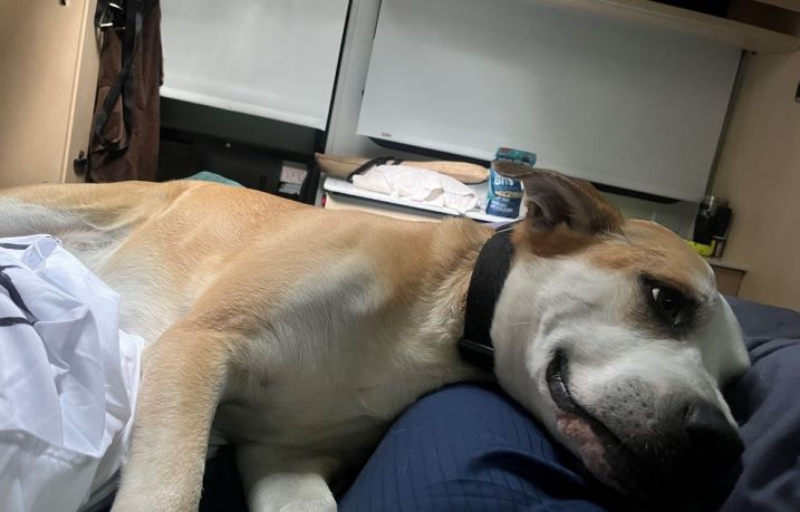
Last year, we took our first short RV trip with Iggy — our 90 lb, lovely, and very reactive dog. I was nervous. Not the usual pre-trip jitters, but the specific anxiety that comes with knowing your dog will be surrounded by strangers, strange smells, unfamiliar sounds, and an endless parade of other dogs with zero warning.
Would he be able to settle during the drives? Would he relax enough to sleep — and if he couldn't, we wouldn't be sleeping much either. I had a lot of questions before we left, and I've had a lot of conversations with other reactive dog owners who asked the same ones.
These are those questions — and what I've learned from living them.
1. How do I handle my reactive dog in a campground where dogs are constantly walking past our site?
The most important thing I can tell you here is this: work on your dog's reactivity before you go. I know that sounds obvious, but I mean it practically. Asking a reactive dog to hold it together in a campground — a new environment with new smells, under the stress of travel — is asking a lot. If they're still working hard to manage themselves at home, the campground will feel like an impossible place. Ideally, you're already working with a trainer, and your dog has some tools in their toolkit before the trip.
That said, management is your best friend on the road, and space is the foundation of management.
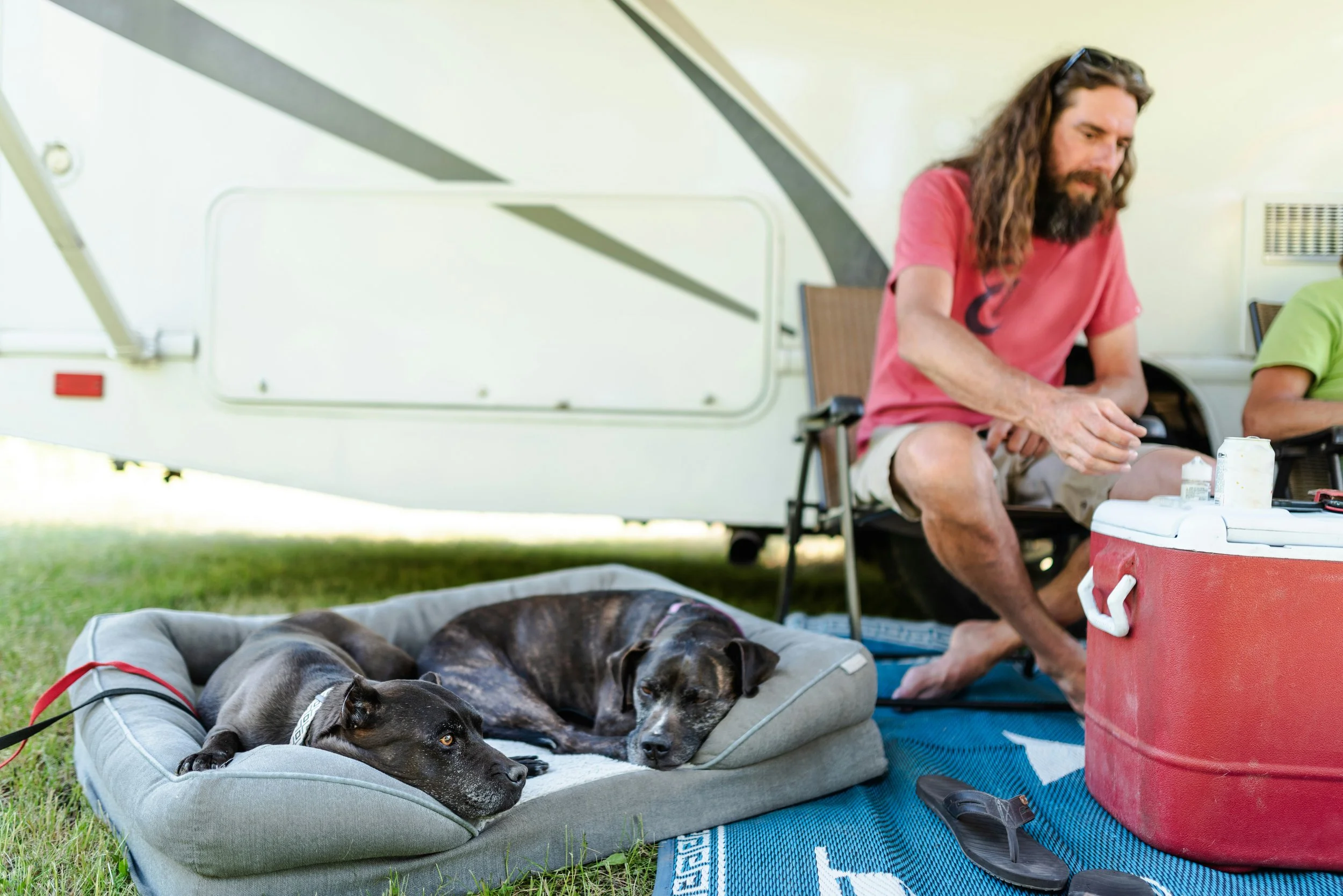
Set up your trailer or tent at the back of your site with the door or opening facing away from the road. You want as much distance as possible between your dog and the foot traffic. The farther back you are, the more buffer you have before something becomes a problem.
If you're tenting, I'd strongly recommend a travel crate as a safe space. A crate gives your dog a place to rest and gives you peace of mind when you need to step away.
And when you're outside? Sit at the back of the site. Keep your dog between you and your travel companion. Stay out of the sightlines. You can't control what other people do with their dogs, but you can control how much your dog sees.
2. What do I do when my dog loses it at another dog in an RV park, and everyone stares?

Oh, this one stings. I know it well.
I've had people stare at us. I've had people shake their heads. I've had well-meaning strangers offer unsolicited advice. The judgment — real or perceived — has a way of sticking around long after the moment passes.
Here's the rule I've given myself: if I saw something coming and did what I could to avoid it, I give myself grace. Most situations can be managed if both owners are paying attention. The problem is, not everyone is.
At one Provincial park, I was walking Iggy on a leash and muzzled — already taking precautions — and stepping into empty campsites whenever I saw someone approaching with a dog. A couple came around the corner, walking a golden retriever on a flexi lead. I moved us to the back of an empty site and stepped behind a tree so Iggy couldn't see the dog. But the golden had spotted us and started pulling toward us, heading right into the site. I could see it was about to hit the end of that flexi lead, which meant it would make Iggy very uncomfortable.
I called out clearly: "My dog is reactive." Only then did the owner reel the dog in.
When a reaction does happen, calmly create distance, keep moving, and take deep breaths.
3. How do I find an Airbnb that's actually safe for a reactive dog — not just "pet friendly"?
"Pet-friendly" is not the same as reactive-dog friendly, and the difference matters.
When I'm looking at a rental for Iggy, I'm not just looking for a place that allows dogs. I'm looking for a place where we can actually function. Here are the questions I ask before I book:
Are there other dogs on the property? A shared property with a resident dog — or a host who has dogs — is a setup for a very stressful stay.
How close is the rental to neighbouring properties? A detached house with some yard buffer is very different from a suite in someone's backyard.
Is there a size or temperament policy? Many listings say "well-mannered pets" without defining what that means. I contact the host directly and ask. Does some barking bother them? Are there noise-sensitive neighbours? Is there a shared entrance? The conversation tells you as much as the answers do.
The extra effort up front saves you an enormous amount of stress once you're actually there.
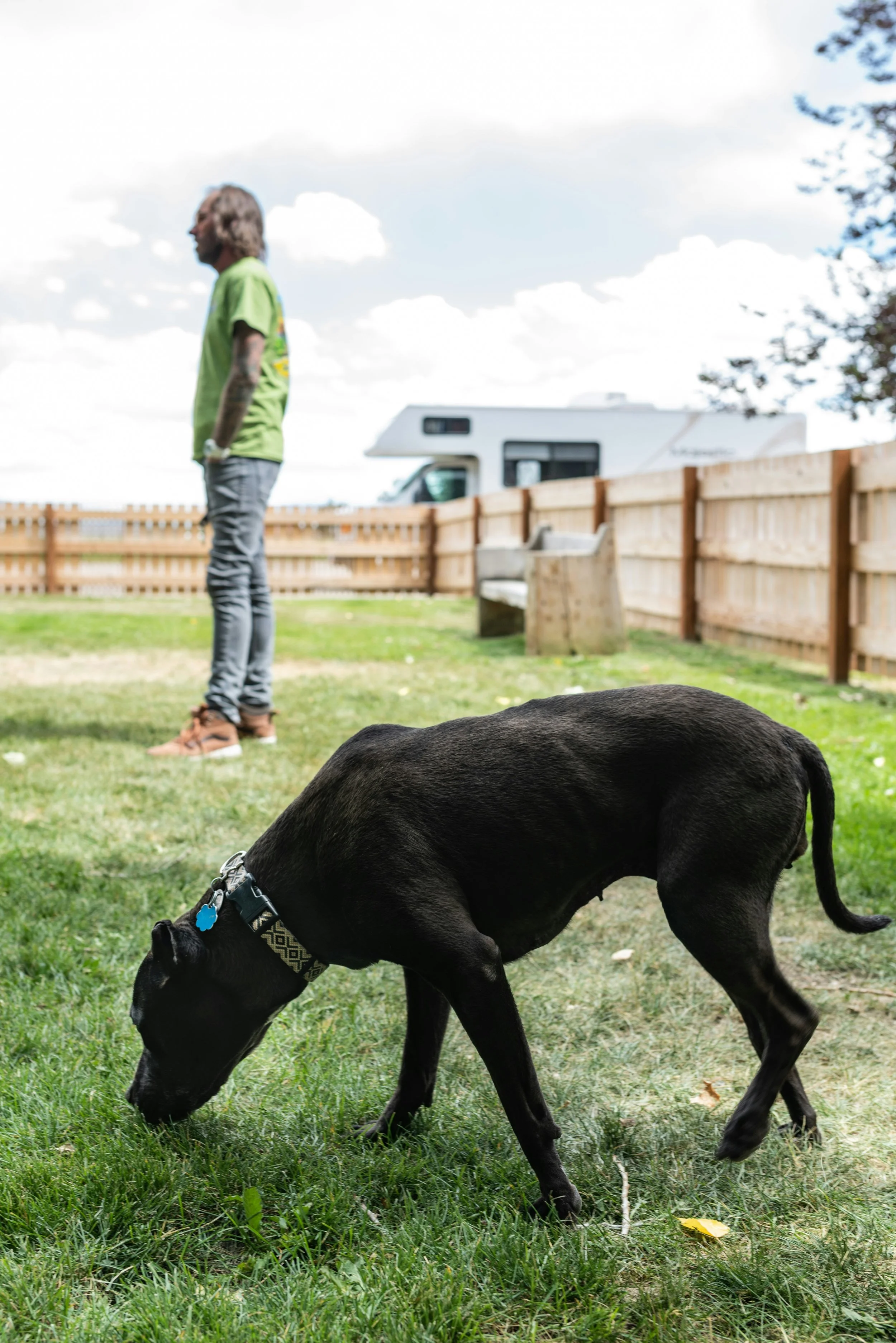
Is there a private, fenced yard or a private Sniffspot nearby? For a reactive dog, a fenced yard isn't a luxury — it's the difference between being able to decompress outside and being on leash every single time you step out the door.
4. How do I set up our campsite or RV space so my dog feels safe instead of on guard the whole time?
Iggy used to have big reactions to delivery trucks, knocks at the door, and people walking down our road. Over time — through consistent training and taking his feelings seriously rather than dismissing them — we've made real progress. But I knew going into that first RV trip that his threshold for an unfamiliar environment would be lower than at home. That's true of most reactive dogs. New place, more anxiety, more reactions.
So I planned for it.
The single most effective thing we did was block his sightlines from inside the RV. When he can't see the dogs and people walking past, he doesn't react to them. It sounds simple, but it changed the entire trip. We used barriers across the front windows so he couldn't sit at the front of the RV and watch the road. Out of sight, genuinely out of mind.
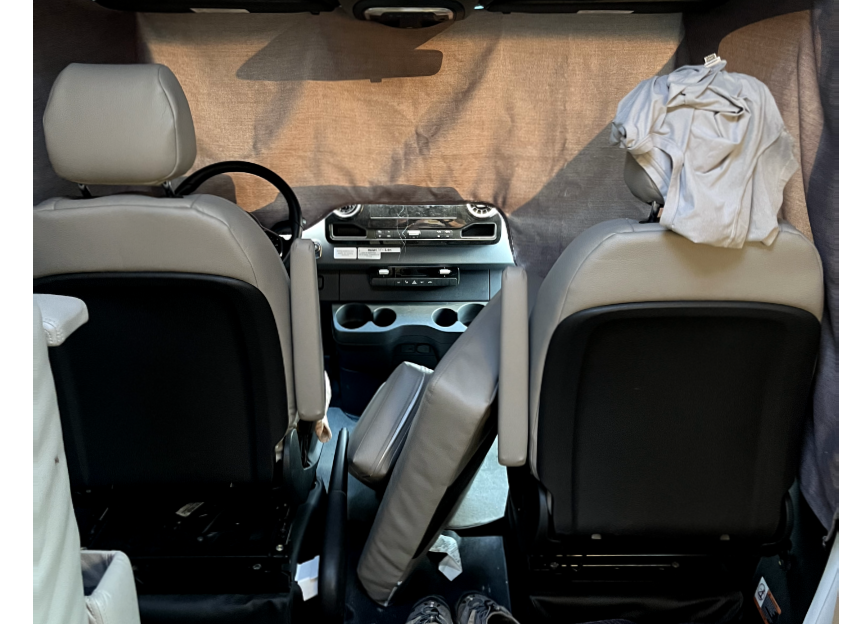
Out of sight, genuinely out of mind.
When we were outside, we sat at the back of the vehicle — always. Iggy was positioned between our chairs, facing away from the main road through the park. If something caught his attention, one of us had a hand free to hold his collar before it escalated.
We also travel with a foldable travel crate that sets up outside in minutes. It gives Iggy shade, a defined space to settle into, and a visual boundary that actually seems to help him relax. A dog who knows where their spot is tends to feel safer in it.
The goal isn't to prevent every trigger — you can't. The goal is to reduce the number of triggers he encounters so that when something does happen, he still has enough in reserve to recover.
5. My dog is already stressed at home — will travel make their reactivity worse?
Short answer: It depends, and I'd rather give you an honest answer than a reassuring one.
If your dog doesn't like travelling in a vehicle, a road trip won't be enjoyable for them, no matter how beautiful the destination. If your dog is easily overwhelmed and slow to adapt, putting them in a new environment full of new triggers is a lot to ask.
But if your dog is nervous about new things while still able to adjust — if they have a threshold that can be managed and a relationship with you that feels like a safe base — travel can actually build confidence. I've seen it with Iggy: Being out in the world with me, navigating things together, and coming out the other side okay has built his resilience to surprises.
If you're not sure which category your dog falls into, start small. A one-night trip somewhere quiet. How soon does your dog recover from the stressors? Do they seem more like themselves in a few hours? Do they sleep? Are they able to eat? Those are your signals.
Expect heightened reactivity during the trip. That's normal. What you're watching for is whether it settles back down — and ideally, whether you come home with a slightly more confident dog than the one you left with.
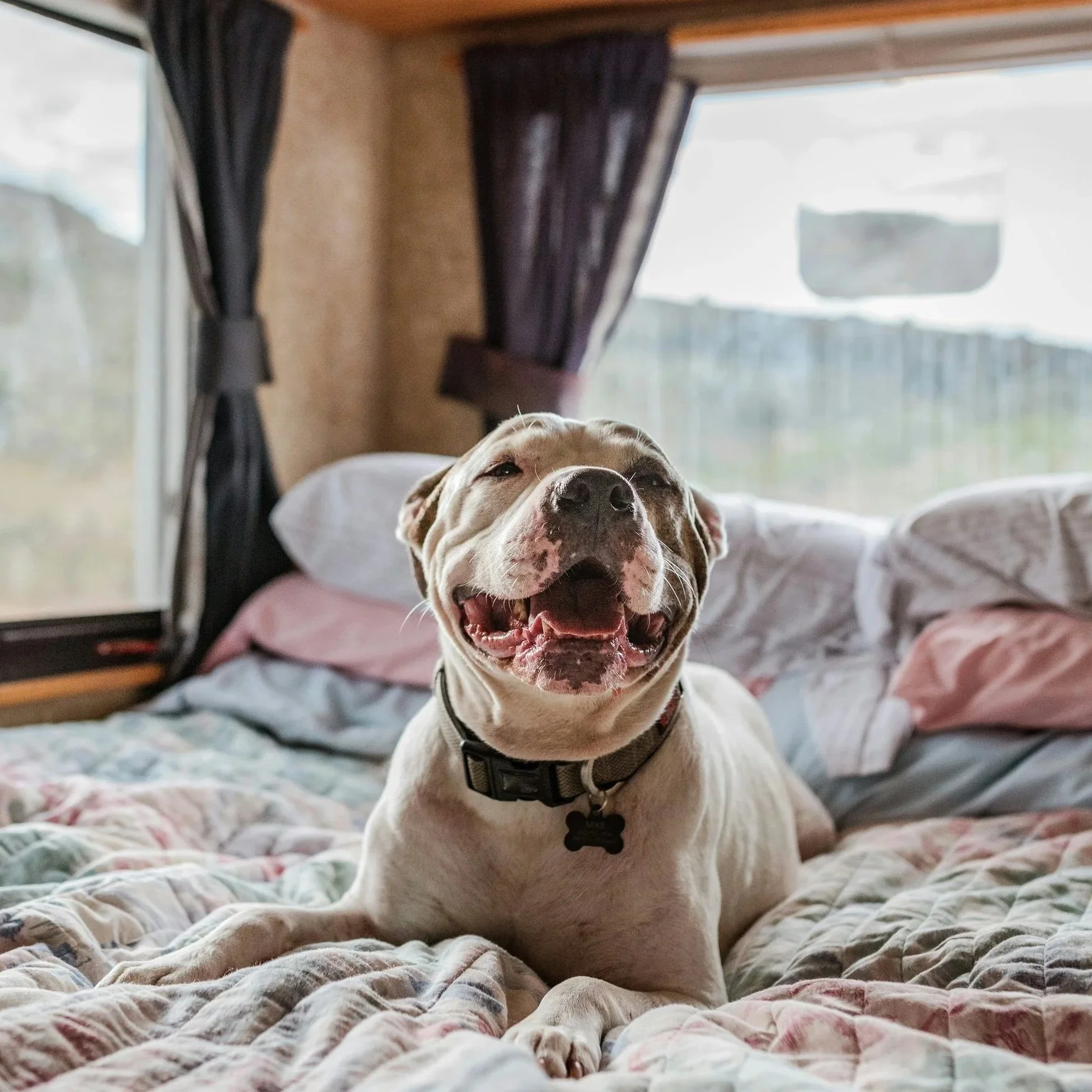
6. How do I handle potty breaks in a busy campground or rest stop without a meltdown?
Rest stops are unavoidable. Busy campground paths are unavoidable. The goal isn't to eliminate these moments — it's to make them as manageable as possible before your dog's feet hit the ground.
Space is your starting point. When you pull in, don't park closest to the building or in the thick of the lot. Pull to the far end, away from the cluster of vehicles. Give yourself room to exit the car without walking into a wall of people and dogs.
Once you're out, scatter a handful of treats on the grass — away from the parking lot if you can. A dog with their nose to the ground is a dog who isn't locked onto a trigger. It also gives them a job, and a nervous dog with a job is a calmer dog. A reactive dog in high alert will actually resist putting their head down because they want to watch the perceived threat — so if your dog is willing to sniff for treats, that's a good sign they're still inside their threshold.
Keep the break short and purposeful. Get them out, let them go, scatter some treats, and get them back in the car before the situation escalates. You can give them a proper decompression walk once you're somewhere with more space and fewer variables.
Travelling with a reactive dog takes more planning, more patience, and more grace — for your dog and for yourself. But it can be done. Iggy and I are proof of that. I hope something in here gives you a clearer picture of what to expect and the confidence to try.
Happy travels!Sherri, owner of Rascals & Rescues
rascalsandrescues.ca
““Chance favours the prepared dog.””
